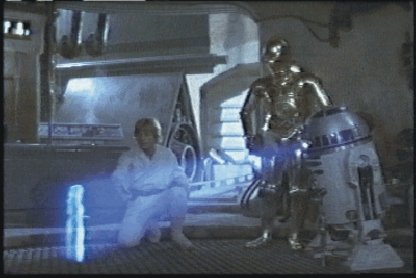
 Princess Leia Hologram (StarWars) by Michael Talbot
In 1982 a remarkable event took place. At the University of Paris a research team led by physicist Alain Aspect performed what may turn out to be one of the most important experiments of the 20th century. You did not hear about it on the evening news. In fact, unless you are in the habit of reading scientific journals you probably have never even heard Aspect's name, though there are some who believe his discovery may change the face of science. Aspect and his team discovered that under certain circumstances subatomic particles such as electrons are able to instantaneously communicate with each other regardless of the distance separating them. It doesn't matter whether they are 10 feet or 10 billion miles apart. Somehow each particle always seems to know what the other is doing. The problem with this feat is that it violates Einstein's long-held tenet that no communication can travel faster than the speed of light. Since traveling faster than the speed of light is tantamount to breaking the time barrier, this daunting prospect has caused some physicists to try to come up with elaborate ways to explain away Aspect's findings. But it has inspired others to offer even more radical explanations.University of London physicist David Bohm, for example, believes Aspect's findings imply that objective reality does not exist, that despite its apparent solidity the universe is at heart a phantasm, a gigantic and splendidly detailed hologram. To understand why Bohm makes this startling assertion, one must first understand a little about holograms. A hologram is a three-dimensional photograph made with the aid of a laser. To make a hologram, the object to be photographed is first bathed in the light of a laser beam. Then a second laser beam is bounced off the reflected light of the first and the resulting interference pattern (the area where the two laser beams commingle) is captured on film. When the film is developed, it looks like a meaningless swirl of light and dark lines. But as soon as the developed film is illuminated by another laser beam, a three-dimensional image of the original object appears. The three-dimensionality of such images is not the only remarkable characteristic of holograms. If a hologram of a rose is cut in half and then illuminated by a laser, each half will still be found to contain the entire image of the rose. Indeed, even if the halves are divided again, each snippet of film will always be found to contain a smaller but intact version of the original image. Unlike normal photographs, every part of a hologram contains all the information possessed by the whole. The "whole in every part" nature of a hologram provides us with an entirely new way of understanding organization and order. For most of its history, Western science has labored under the bias that the best way to understand a physical phenomenon, whether a frog or an atom, is to dissect it and study its respective parts. A hologram teaches us that some things in the universe may not lend themselves to this approach. If we try to take apart something constructed holographically, we will not get the pieces of which it is made, we will only get smaller wholes. This insight suggested to Bohm another way of understanding Aspect's discovery. Bohm believes the reason subatomic particles are able to remain in contact with one another regardless of the distance separating them is not because they are sending some sort of mysterious signal back and forth, but because their separateness is an illusion. He argues that at some deeper level of reality such particles are not individual entities, but are actually extensions of the same fundamental something. To enable people to better visualize what he means, Bohm offers the following illustration. Imagine an aquarium containing a fish. Imagine also that you are unable to see the aquarium directly and your knowledge about it and what it contains comes from two television cameras, one directed at the aquarium's front and the other directed at its side. As you stare at the two television monitors, you might assume that the fish on each of the screens are separate entities. After all, because the cameras are set at different angles, each of the images will be slightly different. But as you continue to watch the two fish, you will eventually become aware that there is a certain relationship between them. When one turns, the other also makes a slightly different but corresponding turn; when one faces the front, the other always faces toward the side. If you remain unaware of the full scope of the situation, you might even conclude that the fish must be instantaneously communicating with one another, but this is clearly not the case. This, says Bohm, is precisely what is going on between the subatomic particles in Aspect's experiment. According to Bohm, the apparent faster-than-light connection between subatomic particles is really telling us that there is a deeper level of reality we are not privy to, a more complex dimension beyond our own that is analogous to the aquarium. And, he adds, we view objects such as subatomic particles as separate from one another because we are seeing only a portion of their reality. Such particles are not separate "parts", but facets of a deeper and more underlying unity that is ultimately as holographic and indivisible as the previously mentioned rose. And since everything in physical reality is comprised of these "eidolons", the universe is itself a projection, a hologram. In addition to its phantomlike nature, such a universe would possess other rather startling features. If the apparent separateness of subatomic particles is illusory, it means that at a deeper level of reality all things in the universe are infinitely interconnected.The electrons in a carbon atom in the human brain are connected to the subatomic particles that comprise every salmon that swims, every heart that beats, and every star that shimmers in the sky. Everything interpenetrates everything, and although human nature may seek to categorize and pigeonhole and subdivide the various phenomena of the universe, all apportionments are of necessity artificial and all of nature is ultimately a seamless web. In a holographic universe, even time and space could no longer be viewed as fundamentals. Because concepts such as location break down in a universe in which nothing is truly separate from anything else, time and three-dimensional space, like the images of the fish on the TV monitors, would also have to be viewed as projections of this deeper order. At its deeper level reality is a sort of superhologram in which the past, present, and future all exist simultaneously. This suggests that given the proper tools it might even be possible to someday reach into the superholographic level of reality and pluck out scenes from the long-forgotten past. What else the superhologram contains is an open-ended question. Allowing, for the sake of argument, that the superhologram is the matrix that has given birth to everything in our universe, at the very least it contains every subatomic particle that has been or will be -- every configuration of matter and energy that is possible, from snowflakes to quasars, from blue whales to gamma rays. It must be seen as a sort of cosmic storehouse of "All That Is." Although Bohm concedes that we have no way of knowing what else might lie hidden in the superhologram, he does venture to say that we have no reason to assume it does not contain more. Or, as he puts it, perhaps the superholographic level of reality is a "mere stage" beyond which lies "an infinity of further development". Bohm is not the only researcher who has found evidence that the universe is a hologram. Working independently in the field of brain research, Standford neurophysiologist Karl Pribram has also become persuaded of the holographic nature of reality. Pribram was drawn to the holographic model by the puzzle of how and where memories are stored in the brain. For decades numerous studies have shown that rather than being confined to a specific location, memories are dispersed throughout the brain. In a series of landmark experiments in the 1920s, brain scientist Karl Lashley found that no matter what portion of a rat's brain he removed he was unable to eradicate its memory of how to perform complex tasks it had learned prior to surgery. The only problem was that no one was able to come up with a mechanism that might explain this curious "whole in every part" nature of memory storage. Then in the 1960s Pribram encountered the concept of holography and realized he had found the explanation brain scientists had been looking for. Pribram believes memories are encoded not in neurons, or small groupings of neurons, but in patterns of nerve impulses that crisscross the entire brain in the same way that patterns of laser light interference crisscross the entire area of a piece of film containing a holographic image. In other words, Pribram believes that the brain is itself a hologram. Pribram's theory also explains how the human brain can store so many memories in so little space. It has been estimated that the human brain has the capacity to memorize something on the order of 10 billion bits of information during the average human lifetime (or roughly the same amount of information contained in five sets of the Encyclopaedia Britannica). Similarly, it has been discovered that in addition to their other capabilities, holograms possess an astounding capacity for information storage--simply by changing the angle at which the two lasers strike a piece of photographic film, it is possible to record many different images on the same surface. It has been demonstrated that one cubic centimeter of film can hold as many as 10 billion bits of information. Our uncanny ability to quickly retrieve whatever information we need from the enormous store of our memories becomes more understandable if the brain functions according to holographic principles. If a friend asks you to tell him what comes to mind when he says the word "zebra", you do not have to clumsily sort back through some gigantic and cerebral alphabetic file to arrive at an answer. Instead, associations like "striped", "horselike", and "animal native to Africa" all pop into your head instantly. Indeed, one of the most amazing things about the human thinking process is that every piece of information seems instantly cross-correlated with every other piece of information--another feature intrinsic to the hologram. Because every portion of a hologram is infinitely interconnected with every other portion, it is perhaps nature's supreme example of a cross-correlated system. The storage of memory is not the only neurophysiological puzzle that becomes more tractable in light of Pribram's holographic model of the brain. Another is how the brain is able to translate the avalanche of frequencies it receives via the senses (light frequencies, sound frequencies, and so on) into the concrete world of our perceptions. Encoding and decoding frequencies is precisely what a hologram does best. Just as a hologram functions as a sort of lens, a translating device able to convert an apparently meaningless blur of frequencies into a coherent image, Pribram believes the brain also comprises a lens and uses holographic principles to mathematically convert the frequencies it receives through the senses into the inner world of our perceptions. An impressive body of evidence suggests that the brain uses holographic principles to perform its operations. Pribram's theory, in fact, has gained increasing support among neurophysiologists. Argentinian-Italian researcher Hugo Zucarelli recently extended the holographic model into the world of acoustic phenomena. Puzzled by the fact that humans can locate the source of sounds without moving their heads, even if they only possess hearing in one ear, Zucarelli discovered that holographic principles can explain this ability. Zucarelli has also developed the technology of holophonic sound, a recording technique able to reproduce acoustic situations with an almost uncanny realism. Pribram's belief that our brains mathematically construct "hard" reality by relying on input from a frequency domain has also received a good deal of experimental support. It has been found that each of our senses is sensitive to a much broader range of frequencies than was previously suspected. Researchers have discovered, for instance, that our visual systems are sensitive to sound frequencies, that our sense of smell is in part dependent on what are now called "osmic frequencies", and that even the cells in our bodies are sensitive to a broad range of frequencies. Such findings suggest that it is only in the holographic domain of consciousness that such frequencies are sorted out and divided up into conventional perceptions. But the most extraordinary aspect of Pribram's holographic model of the brain is what happens when it is put together with Bohm's theory. For if the concreteness of the world is but a secondary reality and what is "there" is actually a holographic blur of frequencies, and if the brain is also a hologram and only selects some of the frequencies out of this blur and mathematically transforms them into sensory perceptions, what becomes of objective reality? Put quite simply, it ceases to exist. As the religions of the East have long upheld, the material world is Maya, an illusion, and although we may think we are physical beings moving through a physical world, this too is an illusion. We are really "receivers" floating through a kaleidoscopic sea of frequency, and what we extract from this sea and transmogrify into physical reality is but one channel from many extracted out of the superhologram. This striking new picture of reality, the synthesis of Bohm and Pribram's views, has come to be called the holographic paradigm, and although many scientists have greeted it with skepticism, it has galvanized others. A small but growing group of researchers believe it may be the most accurate model of reality science has arrived at thus far. More than that, some believe it may solve some mysteries that have never before been explainable by science and even establish the paranormal as a part of nature. Numerous researchers, including Bohm and Pribram, have noted that many para-psychological phenomena become much more understandable in terms of the holographic paradigm. In a universe in which individual brains are actually indivisible portions of the greater hologram and everything is infinitely interconnected, telepathy may merely be the accessing of the holographic level. It is obviously much easier to understand how information can travel from the mind of individual 'A' to that of individual 'B' at a far distance point and helps to understand a number of unsolved puzzles in psychology. In particular, Stanislav Grof feels that the holographic paradigm offers a model for understanding many of the baffling phenomena experienced by individuals during altered states of consciousness. In the 1950s, while conducting research into the beliefs of LSD as a psychotherapeutic tool, Grof had one female patient who suddenly became convinced she had assumed the identity of a female of a species of prehistoric reptile. During the course of her hallucination, she not only gave a richly detailed description of what it felt like to be encapsuled in such a form, but noted that the portion of the male of the species's anatomy was a patch of colored scales on the side of its head. What was startling to Grof was that although the woman had no prior knowledge about such things, a conversation with a zoologist later confirmed that in certain species of reptiles colored areas on the head do indeed play an important role as triggers of sexual arousal. The woman's experience was not unique. During the course of his research, Grof encountered examples of patients regressing and identifying with virtually every species on the evolutionary tree (research findings which helped influence the man-into-ape scene in the movie Altered States). Moreover, he found that such experiences frequently contained obscure zoological details which turned out to be accurate. Regressions into the animal kingdom were not the only puzzling psychological phenomena Grof encountered. He also had patients who appeared to tap into some sort of collective or racial unconscious. Individuals with little or no education suddenly gave detailed descriptions of Zoroastrian funerary practices and scenes from Hindu mythology. In other categories of experience, individuals gave persuasive accounts of out-of-body journeys, of precognitive glimpses of the future, of regressions into apparent past-life incarnations. In later research, Grof found the same range of phenomena manifested in therapy sessions which did not involve the use of drugs. Because the common element in such experiences appeared to be the transcending of an individual's consciousness beyond the usual boundaries of ego and/or limitations of space and time, Grof called such manifestations "transpersonal experiences", and in the late '60s he helped found a branch of psychology called "transpersonal psychology" devoted entirely to their study. Although Grof's newly founded Association of Transpersonal Psychology garnered a rapidly growing group of like-minded professionals and has become a respected branch of psychology, for years neither Grof nor any of his colleagues were able to offer a mechanism for explaining the bizarre psychological phenomena they were witnessing. But that has changed with the advent of the holographic paradigm. As Grof recently noted, if the mind is actually part of a continuum, a labyrinth that is connected not only to every other mind that exists or has existed, but to every atom, organism, and region in the vastness of space and time itself, the fact that it is able to occasionally make forays into the labyrinth and have transpersonal experiences no longer seems so strange. The holographic paradigm also has implications for so-called hard sciences, such as biology. Keith Floyd, a psychologist at Virginia Intermont College, has pointed out that if the concreteness of reality is but a holographic illusion, it would no longer be true to say the brain produces consciousness. Rather, it is consciousness that creates the appearance of the brain -- as well as the body and everything else around us we interpret as physical. Such a turnabout in the way we view biological structures has caused researchers to point out that medicine and our understanding of the healing process could also be transformed by the holographic paradigm. If the apparent physical structure of the body is but a holographic projection of consciousness, it becomes clear that each of us is much more responsible for our health than current medical wisdom allows. What we now view as miraculous remissions of disease may actually be due to changes in consciousness which in turn effect changes in the hologram of the body. Similarly, controversial new healing techniques such as visualization may work so well because, in the holographic domain of thought, images are ultimately as real as "reality". Even visions and experiences involving "non-ordinary" reality become explainable under the holographic paradigm. In his book "Gifts of Unknown Things", biologist Lyall Watson describes his encounter with an Indonesian shaman woman who, by performing a ritual dance, was able to make an entire grove of trees instantly vanish into thin air. Watson relates that as he and another astonished onlooker continued to watch the woman, she caused the trees to reappear, then "click" off again and on again several times in succession. Although current scientific understanding is incapable of explaining such events, experiences like this become more tenable if "hard" reality is only a holographic projection. Perhaps we agree on what is "there" or "not there" because what we call consensus reality is formulated and ratified at the level of the human unconscious at which all minds are infinitely interconnected. If this is true, it is the most profound implication of the holographic paradigm of all, for it means that experiences such as Watson's are not commonplace only because we have not programmed our minds with the beliefs that would make them so. In a holographic universe there are no limits to the extent to which we can alter the fabric of reality. What we perceive as reality is only a canvas waiting for us to draw upon it any picture we want. Anything is possible, from bending spoons with the power of the mind to the phantasmagoric events experienced by Castaneda during his encounters with the Yaqui brujo don Juan, for magic is our birthright, no more or less miraculous than our ability to compute the reality we want when we are in our dreams. Indeed, even our most fundamental notions about reality become suspect, for in a holographic universe, as Pribram has pointed out, even random events would have to be seen as based on holographic principles and therefore determined. Synchronicities or meaningful coincidences suddenly makes sense, and everything in reality would have to be seen as a metaphor, for even the most haphazard events would express some underlying symmetry. Whether Bohm and Pribram's holographic paradigm becomes accepted in science or dies an ignoble death remains to be seen, but it is safe to say that it has already had an influence on the thinking of many scientists. And even if it is found that the holographic model does not provide the best explanation for the instantaneous communications that seem to be passing back and forth between subatomic particles, at the very least, as noted by Basil Hiley, a physicist at Birbeck College in London, Aspect's findings "indicate that we must be prepared to consider radically new views of reality". Michael Talbot was born in Grand Rapids, Michigan on September 29, 1953. He was originally a fiction/ science fiction author. He also contributed articles to The Village Voice and other publications. His non-fiction books include Mysticism And The New Physics, Beyond The Quantum, and The Holographic Universe. Talbot often referenced Stanislav Grof, whose work on Holotropic Breathwork was also of obvious influence.  Home |